Attic Insulation Services for North Houston Homes and Businesses
If your energy bills climb higher every summer while certain rooms stay stubbornly warm, the problem often starts overhead. The attic is the single largest surface where heat enters and escapes a building, and in the North Houston climate that heat load is relentless. Attic temperatures here can exceed 130 degrees on a July afternoon, and without an effective thermal barrier that heat pushes down into your living space, forcing your air conditioner to run longer and work harder than it should.
At ATS Mechanical Services LLC, we treat attic insulation as a core part of a well-functioning comfort system rather than an afterthought. With 31 years of air conditioning and heating knowledge serving both residential and commercial customers, we understand how insulation, ductwork, and equipment interact. An oversized system paired with a poorly insulated attic wastes energy, while a properly insulated attic often lets a correctly sized unit deliver steady, even temperatures throughout the year. This page walks you through how we approach attic insulation from the first inspection to the finished result.
Why Attic Insulation Matters in This Climate
Heat always moves toward cooler areas. During the long cooling season across Cypress, Klein, Spring, The Woodlands, and Tomball, TX, the superheated air in an uninsulated or under-insulated attic radiates downward into your ceilings and rooms. Your air conditioner then fights a constant battle to remove that heat. Adequate insulation slows this transfer, keeping conditioned air inside where it belongs and reducing the runtime that wears out equipment.
The benefit is not limited to summer. On cool winter nights, the same barrier keeps heated air from rising out through the roof. Insulation works in both directions, which is why we consider it a year-round investment. Beyond comfort, a well-insulated attic reduces strain on the compressor and blower motor, which can extend the service life of the heating and cooling equipment you already own.
How We Evaluate Your Attic
Every project begins with a thorough inspection. We do not simply add more material on top of what is already there, because existing insulation may be compressed, water-damaged, or contaminated. We measure the current depth, check for air leaks, and look for signs of moisture, pest activity, or damaged ductwork hidden above the ceiling. These findings shape the recommendation we make.
During the assessment, our technicians examine several factors that determine how your attic performs. Understanding these details helps you see exactly why we recommend a particular solution rather than a one-size-fits-all approach.
- Current R-value: the thermal resistance rating of the existing insulation, which tells us how much protection you already have and how much more is needed.
- Air sealing gaps: penetrations around light fixtures, plumbing stacks, and the attic hatch that let conditioned air escape before insulation can do its job.
- Ventilation balance: the ratio of intake and exhaust venting that keeps the attic from trapping moisture and heat.
- Duct condition: leaks or missing insulation on supply and return ducts running through the attic that waste cooled air.
- Moisture indicators: water stains, mold, or damp insulation that must be corrected before new material is installed.
Understanding R-Value and Coverage Targets
R-value is the standard measure of an insulation material’s resistance to heat flow. The higher the number, the better the material slows heat transfer. For attics in our region, energy guidelines generally call for a high R-value because of the extended cooling demand. When your attic falls short of that target, the insulation is simply not thick enough to hold back the heat, no matter how new it looks.
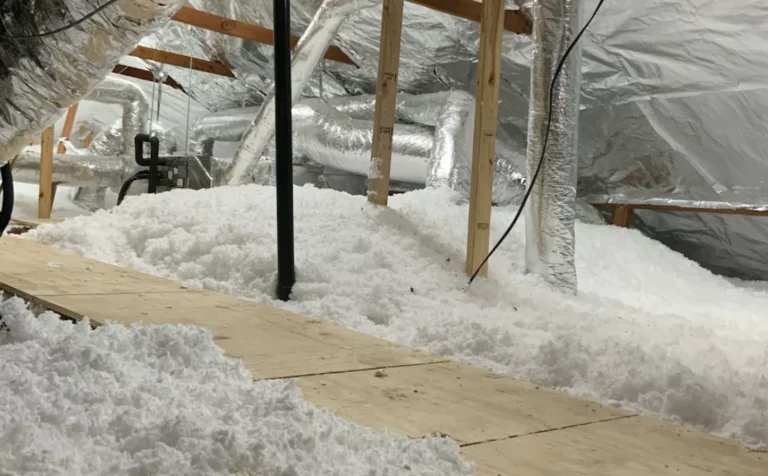
We calculate the coverage your specific attic requires based on the square footage, the existing R-value, and the type of material selected. Blown-in insulation, for example, is applied to a measured depth that corresponds to a target R-value marked directly on coverage charts. Our crews verify that depth across the entire attic floor, not just near the access point, because uneven application leaves weak spots that undermine the whole system.
Insulation Materials We Work With
Different homes and budgets call for different materials, and each has distinct properties. Blown-in fiberglass and blown-in cellulose are common choices for attic floors because they fill irregular spaces and settle evenly around framing, wiring, and fixtures. Both are installed with specialized equipment that distributes the material to a consistent depth, giving reliable coverage even in tight or oddly shaped attics.
Batt insulation, supplied in pre-cut rolls, works well in attics with standard, evenly spaced joists and few obstructions. It provides a predictable R-value per inch and is straightforward to install where the framing cooperates. In some situations, a combination of air sealing and blown-in material over existing batts delivers the best result. During the consultation, we explain the trade-offs so you can make an informed decision about which approach fits your home and goals.
Air Sealing Before Insulating
Insulation slows heat transfer, but it does not stop air movement on its own. If air leaks around recessed lights, top plates, and duct penetrations, conditioned air escapes and hot attic air infiltrates the living space. That is why we address air sealing as a distinct step before adding insulation. Sealing these gaps with the appropriate materials creates a tighter building envelope and allows the new insulation to perform to its rated value.
This step is easy to overlook, and it is one of the most common reasons attics with plenty of insulation still feel uncomfortable. By combining air sealing with proper insulation depth, we deliver a complete thermal barrier rather than a partial fix. The result is more even room temperatures, quieter operation, and a system that cycles less often.
Attic Insulation for Commercial Buildings
Attic and roof insulation is just as important in commercial settings, where large conditioned areas magnify the cost of wasted energy. Offices, retail spaces, and light industrial buildings across Cypress, Klein, Spring, The Woodlands, and Tomball, TX benefit from properly insulated overhead spaces that reduce peak cooling loads and stabilize interior temperatures. Because we serve both residential and commercial customers, we scale our methods to match the size and complexity of the structure.
Commercial projects often involve coordinating around existing rooftop units, larger duct runs, and specific occupancy schedules. Our experience across three decades allows us to plan the work so it fits your operation with minimal disruption. We look at the whole system, from insulation to equipment performance, to recommend improvements that make financial sense over the life of the building.
How Insulation Ties Into Your HVAC System
Attic insulation and your heating and cooling equipment are two halves of the same comfort equation. A high-efficiency air conditioner cannot reach its potential if it is fighting heat pouring in through the ceiling. Likewise, adding insulation to an already struggling system may reveal that the equipment itself is undersized or nearing the end of its service life. Because ATS Mechanical Services LLC handles both insulation and HVAC service, we can evaluate the whole picture and recommend the changes that deliver the greatest return.
Our commitment to ongoing education keeps this integrated approach sharp. Each of our employees completes 200 hours of training every year, staying current with the newest technologies from all manufacturers. That continual investment means the advice you receive reflects up-to-date standards and proven methods, not outdated rules of thumb.
Get Started With ATS Mechanical Services LLC
Improving your attic insulation is one of the most cost-effective ways to lower energy use and make your home or business more comfortable throughout the year. As North Houston’s trusted HVAC repair and replacement service, we bring the same care to insulation that we bring to every air conditioning and heating job we perform.
If you are noticing uneven temperatures, rising utility bills, or an air conditioner that never seems to rest, an attic evaluation is a smart first step. Reach out to ATS Mechanical Services LLC to schedule an inspection, and let our team help you build a comfortable, efficient space that stands up to the demanding local climate.